
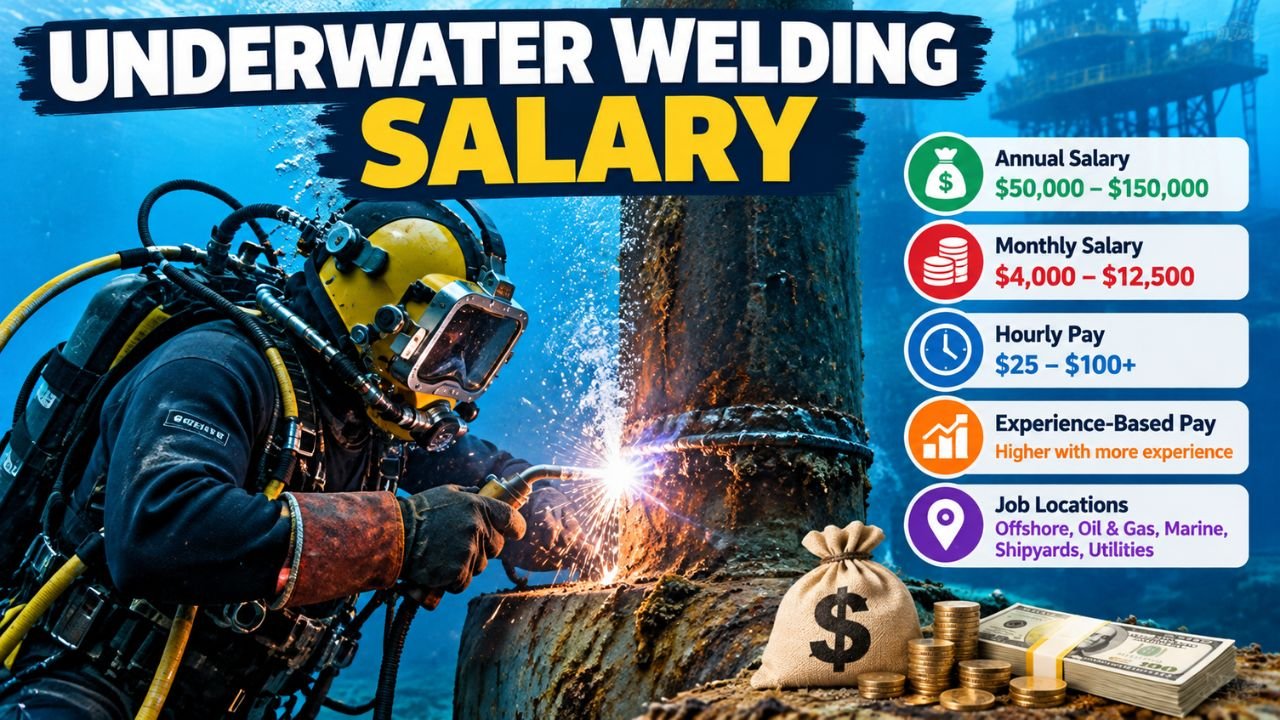
Underwater welding is a uniquely skilled profession that combines technical proficiency in welding with experience in commercial diving. It principally applies to offshore oil & gas. Its applications involve in underwater pipeline, ship repair, dam, bridge and marine construction. As the job involves a considerable amount of expertise and requires working in harsh environments, most people wonder about the underwater welding salary and what kind of qualifications are required to enter this field.
The salary of an underwater welder varies based on experience, location, certifications, project type, working conditions and employer. Newcomers may receive low pay while on-the-job training, while established commercial diving specialists who work in offshore projects can receive significantly higher wages.
What Is Underwater Welding?
What is Underwater Welding?Underwater welding refers to a process of joining, repairing, or maintaining metal structures under water. Depending on the project and experience, welders may work in shallow water or at considerable depths.
| Type | Description |
| Wet welding | Welding is performed underwater using specialized equipment designed for submerged conditions. |
| Dry welding | Welding takes place inside a pressurized underwater chamber that provides a controlled environment. |
| Offshore welding | Welding and repair work associated with offshore platforms, ships, and marine structures. |
| Pipeline welding | Repairing or joining underwater pipelines used in oil, gas, and other industrial operations. |
| Underwater inspection | Examining submerged structures for corrosion, cracks, damage, and maintenance requirements. |
A commercial diving team consists of multiple divers, which always includes a person specializing in underwater welding (called an underwater welder). Must be able to inspect structures, prep metal surfaces, operate welding machines and follow policies.
Underwater Welding Salary: Average Earnings
You see, underwater welding pay depends on the employer, field and country in which you work. Not a single global salary, because there are permanent jobs and temporary offshore contracts for certain positions.
A table with wide sample earning range for career planning These are not verified salary averages, current or projected job offers that you can be guaranteed to get; for all positions, actual pay may vary outside of this range.
| Salary Category | Illustrative Earnings in the USA |
| Entry-level annual earnings | $40,000-$60,000 |
| Mid-career annual earnings | $60,000-$90,000 |
| Experienced specialist annual earnings | $90,000-$150,000+ |
| Monthly equivalent of $60,000 annually | $5,000 |
| Monthly equivalent of $90,000 annually | $7,500 |
| Monthly equivalent of $120,000 annually | $10,000 |
*Monthly equivalents are annual amounts divided by 12, pre-tax and pre-deduction. The ranges presented are illustrative estimates and not live salary statisitics. The actual annual income can be heavily influenced by offshore allowances, overtime, travel or acting without pay.
Underwater Welder Salary by Country
The earnings can vary dramatically depending on country, local demand, what kind of industry activity you have and the certification requirements. The ensuing comparison focuses on the key job markets rather than unverified salary data by country.
| Country | Main Employment Opportunities | Important Salary Factors |
| United States | Offshore energy, commercial diving, marine infrastructure | Diving qualifications, project depth, overtime, and contract terms |
| India | Shipyards, ports, marine maintenance, offshore energy | Employer, experience, diving certification, and project location |
| United Kingdom | Offshore energy, marine construction, ship repair | Offshore qualifications, safety training, and specialist experience |
| Canada | Marine infrastructure, offshore energy, industrial maintenance | Regional demand, diving credentials, and work conditions |
| Australia | Offshore projects, maritime construction, underwater maintenance | Commercial diving qualifications, remote assignments, and specialist skills |
Underwater Welding Salary in India
Underwater welding jobs in india maybe found through marine contractors, shipyards, port service companies, offshore maintenance contractors and industrial diving organizations. Welders, Commercial Divers and Underwater Welding Technicians – Earnings are based on welding workers as employed through these job titles.
| Career Stage | What Usually Influences Pay |
| Beginner | Welding skills, entry-level qualifications, and supervised work experience |
| Experienced worker | Diving experience, welding quality, and the ability to handle more complex assignments |
| Offshore specialist | Project responsibilities, safety record, technical certifications, and contract terms |
| Supervisor or inspector | Leadership, inspection knowledge, documentation, and specialized experience |
Average income of Underwater Welder Estimation in India: There is no one-size-fits-all salary you can tell applicable to all Indian underwater welders. Candidates should compare the fixed salary, offshore allowances, overtime, lodging facilities, insurance₃ and the total number of paid working days before accepting an offer.
Underwater Welding Salary Based on Experience
Experience increases earning potential because companies require personnel capable of performing demanding duties safely and sustainably.
| Experience Level | Typical Career Position | Potential Effect on Earnings |
| 0-2 years | Trainee or junior commercial diving professional | Usually focuses on learning, supervised work, and gaining credentials |
| 2-5 years | Developing underwater welding specialist | May qualify for more technical assignments |
| 5-10 years | Experienced commercial diver or welder | May handle complicated repairs and higher-responsibility projects |
| 10+ years | Senior specialist, supervisor, or inspector | May qualify for leadership and specialized contract roles |
The experience bands are tips to dates in the professional lifecycle, not dictated promotion deadlines. Progress is predicated on training, being able to do the job and need of employer.
Types of Underwater Welding Jobs and Their Earnings Potential
Of course, there is a lot of variation between different roles. Higher paying tasks often include more qualifications, tougher employment or challenging technical expertise.
| Job Role | Main Responsibilities | Factors That Can Increase Pay |
| Commercial diver welder | Welding and underwater maintenance | Diving competence, welding qualifications, and project complexity |
| Offshore underwater welder | Repairs on offshore installations | Offshore experience, safety training, and contract allowances |
| Pipeline repair specialist | Repairing submerged pipelines | Specialized procedures and complex industrial assignments |
| Hyperbaric welding specialist | Welding in a pressurized chamber | Advanced technical knowledge and specialist qualifications |
| Underwater inspection professional | Inspecting structures and documenting defects | Inspection certifications, reporting skills, and experience |
| Diving supervisor | Managing diving teams and worksite safety | Leadership experience, supervisory credentials, and operational responsibility |
Job titles can overlap. A commercial diver may carry out underwater welding, inspection, and maintenance during the same assignment.
Factors That Affect Underwater Welding Salary
The underwater welding salary is influenced by several factors beyond basic welding ability.
| Factor | How It Affects Earnings |
| Experience | Experienced professionals may qualify for more complex and better-paid projects. |
| Diving certification | Employers may require recognized commercial diving qualifications. |
| Welding certification | Relevant welding qualifications can improve access to specialist jobs. |
| Water depth | Deep-water assignments may require additional equipment, planning, and expertise. |
| Project location | Offshore or remote work may include additional allowances. |
| Industry | Offshore energy, marine engineering, and infrastructure projects have different pay structures. |
| Employment type | Permanent jobs, day-rate contracts, and project-based work offer different compensation arrangements. |
| Safety record | Reliable performance and compliance with safety procedures are important for continued employment. |
| Technical specialization | Pipeline work, inspection, and hyperbaric welding may require additional skills. |
A high per day rate does not equal a big annual salary. Contract gaps, delayed by weather events, pre-season training mandates and travel time could also erode some of the overall annual earnings.
How Much Do Underwater Welders Earn Per Month?
Monthly earnings depends on the salary, payment scheme and No. of days work done. For instance, take a professional that earns $72k a year; the simple monthly equivalent is $6k pre-tax.
| Annual Earnings | Monthly Equivalent Before Tax |
| $36,000 | $3,000 |
| $48,000 | $4,000 |
| $60,000 | $5,000 |
| $72,000 | $6,000 |
| $96,000 | $8,000 |
| $120,000 | $10,000 |
These numbers are used as illustrations and not a forecast on what any individual underwater welder will make. If you’re a contractor, you may get paid on a daily or per project basis rather than every month.
Underwater Welding Salary vs. Regular Welding Salary
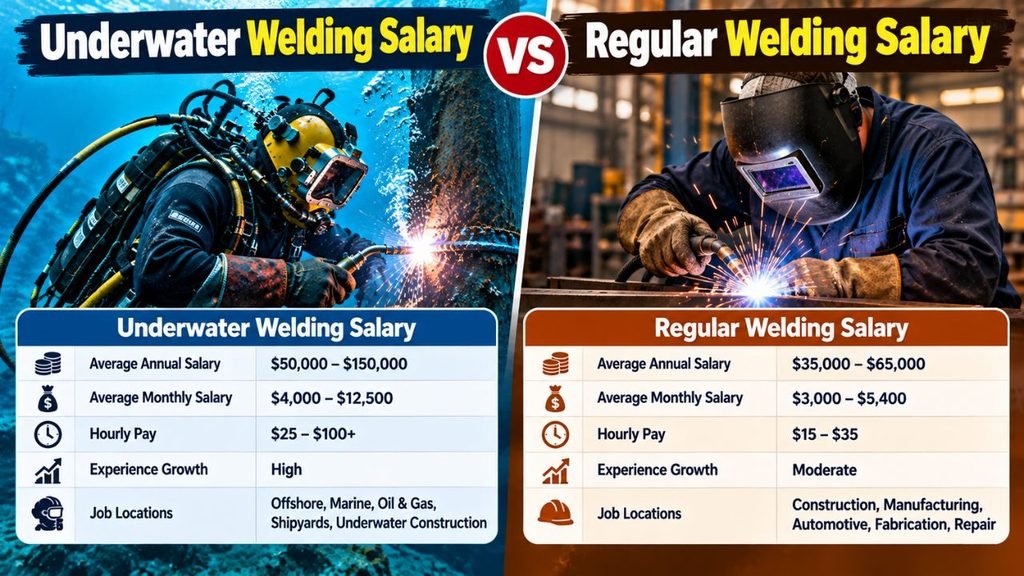
Some of the more specialist roles that fall into underwater welding may command a higher salary, however this career path requires more training, and at times forces workers to work in harsher environments.
| Comparison | Regular Welder | Underwater Welder |
| Working environment | Workshops, factories, construction sites, and industrial facilities | Underwater structures, shipyards, offshore sites, and pressurized chambers |
| Core skills | Metal joining, welding procedures, and equipment handling | Welding skills plus commercial diving and underwater work procedures |
| Training requirements | Welding training and relevant qualifications | Welding training, commercial diving credentials, and role-specific certifications |
| Main risks | Burns, fumes, electric shock, and eye injuries | Diving hazards in addition to welding-related hazards |
| Earning potential | Varies by industry and specialization | Can be higher for certain offshore and specialist contracts |
| Job availability | Broad across manufacturing and construction | More specialized and dependent on project demand |
Not every underwater welding job pays more than any typical welding job. There are industrious welders that get relatively high pay rates — underwater work can leave a long opportunity for downtime, but it tends to come with few of overheads.
Skills Required to Become an Underwater Welder
Candidates generally require a variety of technical, physical and safety skills.
| Skill | Why It Matters |
| Welding techniques | Helps produce strong, reliable joints according to specifications. |
| Commercial diving | Enables safe underwater movement and task performance. |
| Equipment handling | Supports the correct use of welding and diving equipment. |
| Communication | Allows coordination with surface teams and other divers. |
| Problem-solving | Helps address difficult work conditions and unexpected technical issues. |
| Physical fitness | Supports the demands of diving, equipment use, and challenging environments. |
| Safety awareness | Helps identify hazards and follow approved procedures. |
| Attention to detail | Reduces defects and supports inspection and quality requirements. |
Education, Training, and Certification Requirements
There is no single qualification pathway for every country or employer. Candidates should verify the requirements for the specific role and location before investing in training.
| Step | Recommended Action |
| Learn welding | Complete relevant welding training and develop practical skills. |
| Gain experience | Build competence in appropriate welding processes and materials. |
| Complete commercial diving training | Attend a reputable program recognized for the intended employment market. |
| Obtain relevant certifications | Meet the welding, diving, medical fitness, and safety requirements of the employer and jurisdiction. |
| Gain supervised experience | Develop underwater work skills under qualified professionals. |
| Apply for specialist roles | Target suitable marine contractors, shipyards, offshore companies, and industrial diving firms. |
Training should never be rushed. Underwater welding is safety-critical work, and candidates should NOT attempt professional underwater welding without appropriate qualifications, equipment & supervision and approved procedures.
Is Underwater Welding a High-Paying Career?
Underwater welding can also be a high-paying job for qualified applicants who obtain certification and pursue specialized offshore work. But salary is not the only factor to consider, with risk, training costs, hours and career prospects also important facets.
| Potential Advantage | Potential Disadvantage |
| Access to specialized industrial projects | High training and certification requirements |
| Opportunities in marine and offshore industries | Potentially hazardous working conditions |
| Possibility of higher compensation for specialist work | Contract work may be irregular |
| Opportunities to advance into inspection or supervision | Extended travel and time away from home |
| Development of valuable technical skills | Strict medical and safety requirements |
Those contemplating this career will have to determine if they are willing to confront diving, hazardous working conditions and strict emergency protocols – not merely the potential of a big paycheck.
Risks and Challenges of Underwater Welding
Hazards of underwater welding must be trained for, and there is a rigorous approach to risk management in this profession. The risks Associated with each task would be different: pressure injury, entanglement, visibility, cold water, equipment malfunction, electric shock along rescue conditions.
| Challenge | Importance |
| Pressure and depth | Diving procedures must account for depth and pressure-related hazards. |
| Electrical safety | Specialized equipment and approved procedures are essential. |
| Limited visibility | Divers may need additional planning and communication. |
| Equipment reliability | Inspection and maintenance are critical before and during work. |
| Fatigue | Long shifts and demanding conditions require effective work-rest planning. |
| Emergency response | Trained teams and suitable emergency arrangements are essential. |
Safety requirements should always take priority over deadlines or financial incentives.
Career Growth and Future Job Opportunities
Underwater welders can develop their careers by building experience and pursuing additional technical qualifications. Opportunities depend on regional demand and the availability of marine, offshore, and infrastructure projects.
| Career Path | Possible Development |
| Junior commercial diver | Develop diving and underwater maintenance skills. |
| Underwater welding specialist | Gain experience in more complex welding assignments. |
| Pipeline repair specialist | Focus on specialized pipeline inspection and repair work. |
| Inspection professional | Develop relevant inspection, testing, and reporting skills. |
| Diving supervisor | Progress toward planning and supervising diving operations. |
| Offshore project specialist | Build experience in complex industrial and marine projects. |
Long-term growth often depends on combining practical ability with a strong safety record, recognized qualifications, communication skills, and the ability to work effectively in a team.
FAQ About Underwater Welding Salary
1.How much does an underwater welder earn per year?
Annual earnings vary by country, experience, qualifications, and project type. Some specialists working on offshore contracts may earn substantially more than entry-level professionals, but no particular salary is guaranteed.
2. Can underwater welders earn $100,000 a year?
Yes, earning $100,000 or more annually is possible in some specialist roles and employment markets. However, it depends on contract rates, experience, available working days, and the type of projects completed.
3. Is underwater welding a high-paying job in India?
It can be a specialized career with good earning potential, but compensation varies significantly between employers and projects. Candidates should compare actual job offers rather than relying on international salary figures.
4. Do underwater welders get paid by the hour or by the project?
Payment structures vary. Some workers receive annual salaries, while others are paid hourly, daily, or by contract. Offshore allowances and overtime may also form part of compensation.
5. Does underwater welding experience increase salary?
Experience can improve access to complex projects and supervisory roles. However, increases are not automatic and depend on qualifications, performance, and industry demand.
6. Is underwater welding a dangerous career?
Yes. It involves diving hazards alongside welding-related risks. Proper commercial diving training, medical fitness, equipment, supervision, and emergency planning are essential.
Conclusion
The underwater welding salary is based on a balance of experience, ability, commercial diving credentials, location and job type. While offshore and specialist jobs may pay relatively high wages, revenues can be quite variable due to contract timings and market conditions.
If you are thinking of pursuing this career, your best first step is to hone your welding skills, seek out commercial diving certifications, and then get experience under supervision. By checking real job postings, you get a more realistic idea of the salary for the position as well as allowances and insurances, your training costs and working conditions.
Also Read: 2 LPA In Hand Salary | Army Clerk Salary in India | 5.5 LPA In Hand Salary
2400 Grade Pay Salary | Pharmacist Salary in India | Income Tax Officer Salary