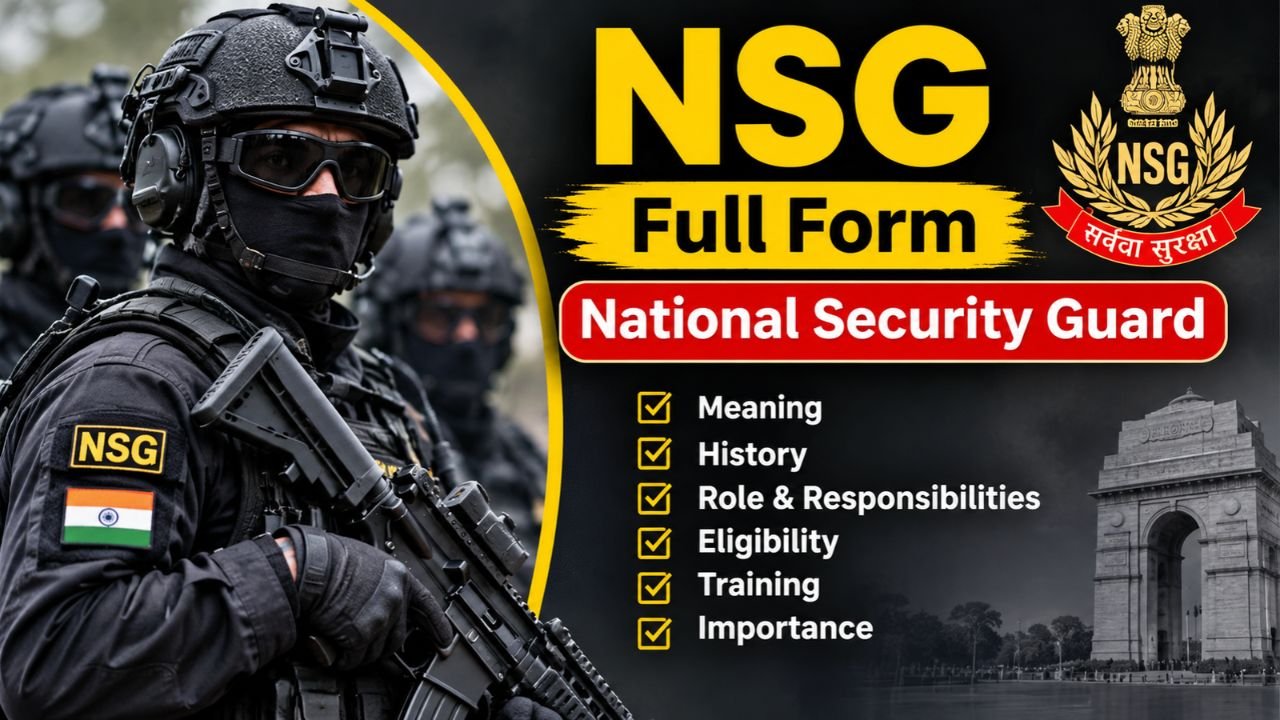
India has many different specialized security forces which help to provide protection to the nation from both inside and outside dangers. One of the highest trained and most specialized of all those security forces is the National Security Guard (NSG). The primary job of the NSG is to deal with serious terrorist incidents, hostage situations, aircraft hijackings, and other high-risk security operations.
The NSG Full Form is National Security Guard. The National Security Guard is a special counter-terrorism unit that operates under the control of the Ministry of Home Affairs (MHA), Government of India. The NSG commandos are referred to as Black Cat Commandos due to their black uniform and specialized training.
The purpose of this article is to examine the meaning of the NSG (National Security Guard), the history of the NSG, the role of the NSG, how the NSG is organized, the training of the NSG and the significance of the NSG to the protection of India’s National Security.
What Is the NSG Full Form?
The full name of the NSG is National Security Guard. It is an elite security team formed to address critical security issues, such as terrorist attacks and major security risks.
The National Security Guard (NSG) is an elite group of specialized forces that operate under the jurisdiction of India’s Ministry of Home Affairs. They are trained specifically to handle high-risk operations including but not limited to, terrorist attacks, hostage negotiations and aircraft hijackings. Unlike standard police units, the NSG has received extensive training on how to handle extremely dangerous events.
“The motto of the organization is “Sarvatra Sarvottam Suraksha”, meaning “Everywhere Best Protection”.”
Also Read: 7.5 LPA In Hand Salary | Community Health Officer Salary
History and Establishment of NSG
The National Security Guard was formed in order to enhance India’s capacity to deal with significant terrorist attacks. In the 1980’s, it became clear that there was a requirement for a specialized force to manage complex security operations.
The Union Cabinet made a decision in 1984 to create an exclusive counter terrorism force. This force was created on October 16th, 1984, and has been operating under the National Security Guard Act since 1986.
The President gave his approval to the bill on September 22, 1986. This was the basis for the establishment of the organization and the defining of its role.
The NSG was established based upon the study of specialized units used in various countries, such as Great Britain’s SAS, and Germany’s GSG 9.
Since the founding of the organization, it has acquired specific skills to perform counter-terrorism operations, save hostages and complete other very risky security tasks.
Why Is NSG Called the Black Cat Commandos?
The National Security Guard (NSG) is commonly referred to as “Black Cat Commandos” due to the unique appearance of their all-black uniform and body armor.
This is because the name reflects who they are, what they do, and how well they can function under pressure. Their training is rigorous and physically, mentally, and tactically challenging so that they will be prepared to take on high risk tasks.
The job requires great teamwork, rapid decision-making, physical conditioning, and being able to maintain your composure in stressful situations.
The name “Black Cat” has been adopted by many Indians and is synonymous with specialized counter-terrorism operations.
Main Roles and Responsibilities of NSG
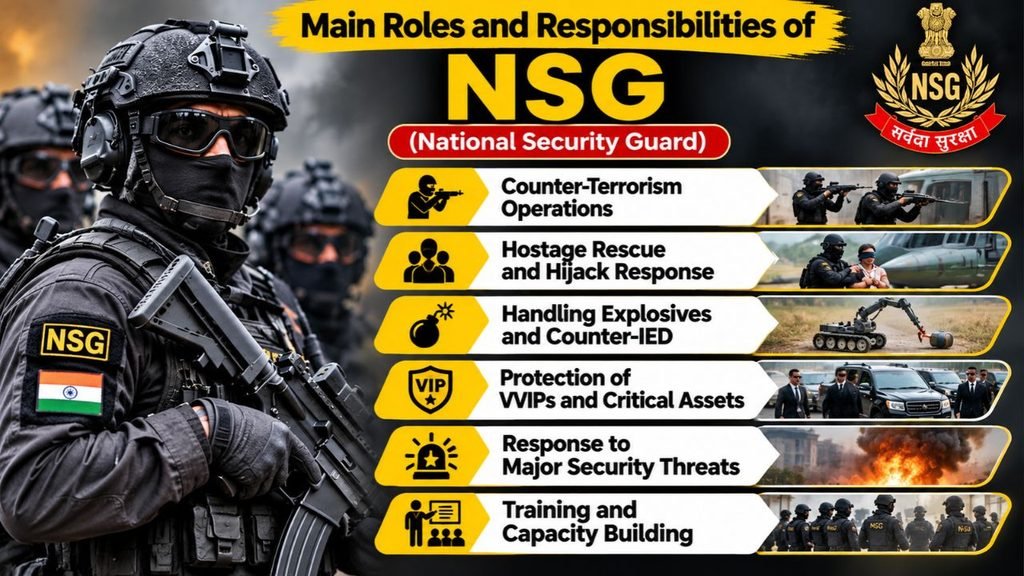
The National Security Guard (NSG) has as its first priority to handle very severe terrorist threats and special security circumstances.
Some of its important responsibilities include:
Anti-Terrorism Operations
One of the main roles of NSG is responding to severe terrorist risks. They have special teams that can be called upon during extreme risk events, such as when terrorists attack high security areas.
Hostage Rescue Operations
The National Security Guard (NSG) is a specialized unit within India’s paramilitary forces, which has been trained to deal with incidents in which innocent civilians have been taken hostage by terrorists or other armed groups.
The execution of such an operation requires thorough preparation, organization, and training of personnel to ensure that the lives of those held hostage are protected.
Anti-Hijacking Operations
The force is additionally trained to respond to threats regarding aircraft hijacking and other significant security issues related to transport.
The preparation required for these types of operations will be based on special requirements and collaboration with appropriate security organizations.
VIP Security
NSG employees can also provide specialized security services for specific individuals who have been identified as having high risk levels, if the federal government requires it.
Bomb Disposal and Related Activities
This agency possesses expert knowledge in assessing bomb threats, ensuring the safety of explosives, and providing support for post-blast investigations.
These responsibilities help strengthen India’s overall security infrastructure.
Organizational Structure of NSG
The National Security Guard consists of two primary operational components: the Special Action Group (SAG) and the Special Ranger Group (SRG).
1. Special Action Group (SAG)
The Special Action Group is comprised of personnel who are selected from the Indian Army. The group is responsible for conducting special operations and direct counter-terrorism missions.
Members are trained intensively for the handling of dangerous and risky events that require the use of highly specialized tactics.
2. Special Ranger Group (SRG)
The Special Ranger Group is made up of individuals from both Central Armed Police Forces (CAPFs) and State Police Forces (SPFs).
The position will support the organizations operating needs, and also perform specialized functions as required by management.
Both teams are collaborating on improving the National Security Guard’s operational capabilities.
NSG Training and Selection Process
The NSG has a unique way of hiring its staff. This is called a “deputation based process.” The main sources of NSG personnel include the Indian Army, Central Armed Police Forces, and State Police.
Candidates are required to have met the relevant eligibility, service, medical and professional requirements of their parent organization.
Personnel who are selected will receive rigorous training to develop their physical conditioning, mental stamina, self-control, collaborative work skills, and ability to perform job duties.
The training may include areas such as:
- Physical fitness and endurance.
- Tactical awareness and teamwork.
- Counter-terrorism preparation.
- Specialized weapons training.
- Hostage rescue techniques.
- Crisis management.
- Bomb threat response.
- Mental strength and decision-making.
The goal of this program is to help individuals develop the skills necessary to respond to unique security threats.
Important NSG Operations in India
Throughout its existence, the National Security Guard has taken part in many critical security missions.
One of the most well-known activities performed by this organization occurred in November of 2008 when they responded to the terrorist attack that hit the city of Mumbai.
In addition to responding to other attacks during that period, NSG commandos were also involved in Operation Black Tornado, which targeted terrorist operations at three key sites: the Taj Mahal Palace Hotel, the Oberoi-Trident Hotel and the Nariman House.
This operation showed how important it is to have special counter-terrorism resources to deal with difficult security problems in large cities.
In addition to being involved in many major counter-terrorism operations, the National Security Guard was involved in the Akshardham Temple operation in Gujarat during 2002.
The development of India’s specialized security response capability has been greatly aided by these operations.
Headquarters and Regional Hubs of NSG
The main office of the National Security Guard is situated in New Delhi. The primary operational and training facilities for this organization are located at Manesar in Haryana.
The organization has set up regional offices in order to better address emergency situations throughout various regions of India.
Important NSG hubs include:
- Mumbai, Maharashtra
- Chennai, Tamil Nadu
- Hyderabad, Telangana
- Kolkata, West Bengal
- Gandhinagar, Gujarat
The location provides additional geographic coverage and operations capability for the organization.
Difference Between NSG and Other Security Forces
India has several security organizations, and each has different responsibilities.
| Security Force | Main Responsibility |
| NSG | Specialized counter-terrorism and high-risk security operations |
| CRPF | Internal security and law-and-order support |
| BSF | Border security |
| CISF | Security of important industrial and government installations |
| ITBP | Border security along the India-China border |
| Indian Army | Defence of the country against external military threats |
The NSG Full Form represents a specialized force with responsibilities that differ from those of regular police and other security organizations.
Importance of NSG in India’s National Security
The National Security Guard contributes significantly to improving the national security infrastructure of India. Special training and well-trained personnel are required to deal with terrorist attacks, hostage situations, and other high-risk situations.
NSG is a specialized unit of the Indian government that can respond to unique security threats.
The unique training that is given to its employees, its operational experience, and the manner in which it coordinates with other security agencies all help the nation prepare for emergencies related to security.
The organization also works on increasing the public’s knowledge of, and preparation for, attacks by providing education and working together with other law enforcement agencies.
Frequently Asked Questions (FAQs)
1. What is the NSG Full Form?
NSG stands for National Security Guard. It is a specialized counter-terrorism force under the Ministry of Home Affairs, Government of India.
2. What is the full form of NSG in India?
The full form of NSG in India is National Security Guard. It is responsible for handling serious terrorist threats and exceptional security situations.
3. Why are NSG commandos called Black Cats?
NSG commandos are popularly called Black Cat Commandos because of their distinctive black uniforms and specialized equipment.
4. When was NSG established?
The NSG was raised on October 16, 1984. Its legal framework was formalized through the National Security Guard Act, 1986.
5. Who controls the NSG in India?
The National Security Guard functions under the Ministry of Home Affairs, Government of India.
Conclusion
Understanding what the NSG stands for allows individuals to understand the nature of the National Security Guard, which is considered to be one of the most elite security organizations in India. The National Security Guard is responsible for providing protection against the most severe forms of terrorism, as well as responding to extreme security emergencies.
The personnel of the “Black Cat Commandos” have been trained to carry out difficult missions which require them to work together as a team with high levels of discipline, courage and special skills.
The National Security Guard (NSG) has contributed significantly to India’s national security in many different ways; these include but are not limited to counter-terrorism, hostage rescue, and anti-hijacking. The NSG is able to provide specialized assistance to India’s national security because of its commitment to its motto “Sarvatra Sarvottam Suraksha”, which translates into “Everywhere Best Protection.”
Also Read: SIS Security Salary in India | Panchayat Sachiv Salary | Assistant Section Officer Salary