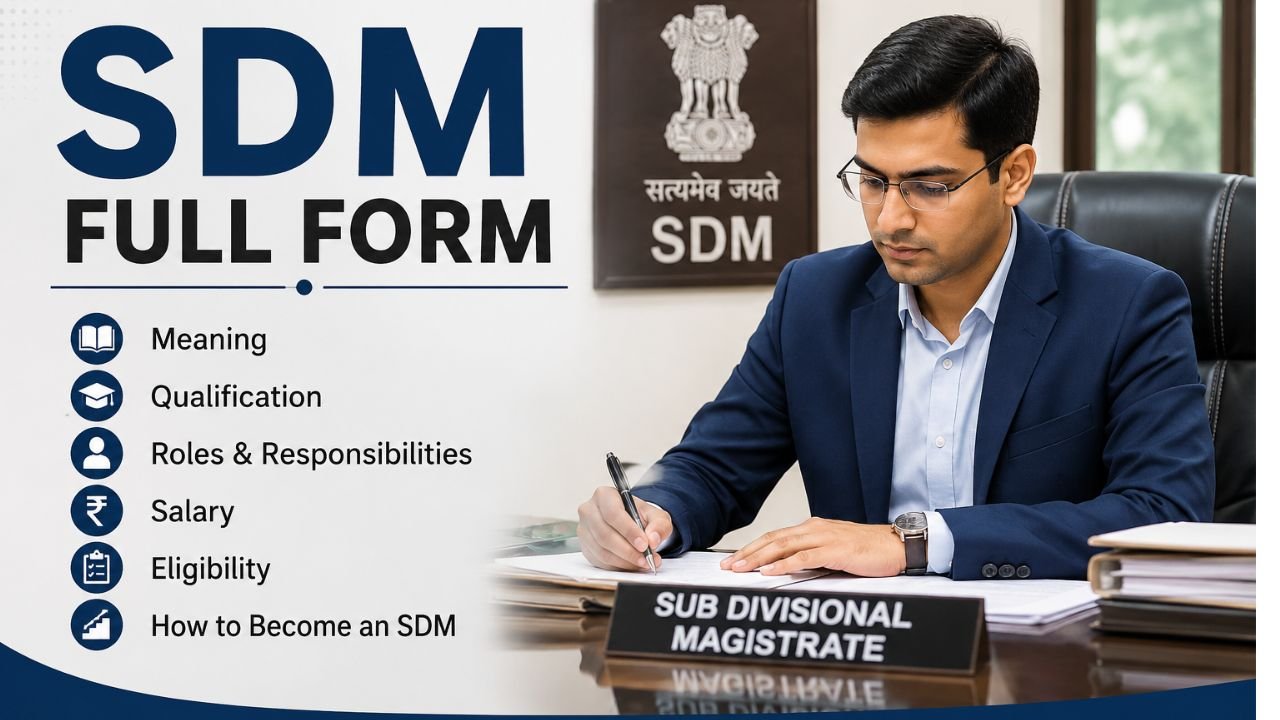
The SDM is one of the most prestigious administrative jobs in India. A Dream Position for Students Every year, thousands of aspirants dream to be an SDM (Sub-Divisional Magistrate) because this post provides power, duties and opportunity to serve the people. The SDM is responsible for law and order, executing government schemes, supervising revenue administration in a sub-division and overseeing other departments.
SDM Full Form, Eligibility, Qualification, Age Limit, Salary Powers Duties Selection Process and Career Growth
SDM Full Form
A Sub-Divisional Magistrate (SDM) is the head of a sub-division within a District. An officer who works under the District Magistrate (DM) or District Collector to keep rule of law, revenue administration as well as carry out policy of the government
| Abbreviation | Full Form |
| SDM | Sub-Divisional Magistrate |
Who is an SDM?
A Sub-Divisional Magistrate (often shortened to SDM) is a government official who controls the administration of a sub-division in a district. The officer is basically the executive head of a sub-division and liaises with other State Departments.
In addition to administrative powers, an SDM is also entrusted with judicial and revenue responsibilities. The SDM plays a leading role in handling emergencies, elections, natural disasters and law and order situations.
SDM Full Form in Hindi
The SDM Full Form in Hindi is:
उप मंडल मजिस्ट्रेट (Sub-Divisional Magistrate)
In some states, SDM is also referred to as:
- उप जिला अधिकारी (Up Zila Adhikari)
- उप मंडल अधिकारी (Sub-Divisional Officer)
Roles and Responsibilities of an SDM
An SDM performs several important administrative and legal responsibilities.
Major Duties of SDM
- All anti social elements.in the sub. division will be in check and the law Joe orders in the sub. Division will be maintained as usual.
- Supervise revenue collection.
- Take care of land disputes and revenue cases
- Issue various government certificates.
- Conduct election-related duties.
- Monitor disaster management activities.
- There are state and central government schemes.
- Work with police and local authorities.
- Oversee development projects.
- Execute welfare programs with transparency.
Powers of an SDM
A Sub-Divisional Magistrate has several executive and magisterial powers.
Key Powers
- Under Criminal Procedure Code (CrPC) and possessing Executive Magistrate powers.
- Authority to trigger Section 144 as and when required.
- at the time of land acquisition and revenue administration.
- Inspection of government offices.
- Disaster and emergency management authority.
- Validation & Approval for Several Government Documents.
- Coordination with law enforcement agencies.
Eligibility to Become an SDM
Candidates must fulfill certain educational and age requirements before applying.
| Criteria | Requirement |
| Nationality | Indian Citizen |
| Educational Qualification | Bachelor’s Degree from a recognized university |
| Minimum Qualification | Graduation |
| Age Limit | Generally 21-40 years (varies by State PSC) |
| Selection | UPSC or State Public Service Commission |
Educational Qualification for SDM
A candidate needs to: – You must train for SDM training course.
- Complete graduation in any discipline.
- Get a graduate from a reputed university.
- Candidates in the final year can also apply for some exams, as per eligibility rules.
The stream has no restriction. Expression Semi Final for candidates of Science, Commerce, Arts, Engineering Medical or Law.
Age Limit for SDM
The age limit depends on the recruitment authority.
General Age Criteria
| Category | Age Limit |
| General | 21-40 Years |
| OBC | Age relaxation as per rules |
| SC/ST | Age relaxation as per government norms |
| PwD | Additional relaxation as applicable |
How to Become an SDM?
There are two primary ways to become an SDM.
1. Through State PCS Examination
Most SDMs are recruited through the State Public Service Commission (PCS) examination.
Selection Process
- Preliminary Examination
- Main Examination
- Interview
- Document Verification
- Medical Examination
- Final Merit List
Successful candidates are appointed as SDMs or other administrative officers depending on their rank.
2. Through UPSC Civil Services Examination
Candidates selected for the Indian Administrative Service (IAS) through UPSC may also serve as SDMs during their initial postings after training.
SDM Salary in India
The salary of an SDM varies from state to state according to the applicable pay structure.
| Component | Amount |
| Basic Pay | ₹56,100 per month (Level-10) |
| Grade Pay | As per government rules |
| Dearness Allowance (DA) | Applicable |
| House Rent Allowance (HRA) | Applicable |
| Travel Allowance (TA) | Applicable |
| Gross Monthly Salary | Approximately ₹70,000–₹1,00,000+ |
In addition to salary, SDMs receive several government benefits and allowances.
Also Read: IPS Salary in India | Full Stack Developer Salary in India
Facilities Provided to an SDM
An SDM enjoys numerous official facilities, including:
- Government residence
- Official vehicle
- Driver
- Office staff
- Medical benefits
- Pension benefits
- Security (where applicable)
- Telephone and internet allowance
- Leave travel concessions
Skills Required to Become an SDM
A successful SDM should possess the following skills:
- Leadership
- Decision-making ability
- Communication skills
- Administrative knowledge
- Public speaking
- Time management
- Problem-solving
- Crisis management
- Team coordination
- Integrity and honesty
Career Growth of an SDM
An SDM can receive promotions based on seniority, experience, and performance.
Promotion Hierarchy
- Sub-Divisional Magistrate (SDM)
- Additional District Magistrate (ADM)
- District Magistrate (DM)/Collector
- Divisional Commissioner
- Senior Administrative Positions
Difference Between SDM and DM
| Feature | SDM | DM |
| Full Form | Sub-Divisional Magistrate | District Magistrate |
| Area of Administration | Sub-Division | Entire District |
| Reports To | District Magistrate | State Government |
| Responsibility | Revenue & Administration | Complete District Administration |
| Rank | Junior to DM | Senior Administrative Officer |
Advantages of Becoming an SDM
- Prestigious government job
- Excellent salary
- High social respect
- Job security
- Promotion opportunities
- Government accommodation
- Official vehicle
- Opportunity to serve society
- Administrative authority
- Pension and retirement benefits
Interesting Facts About SDMs
- DMs are further bifurcated into subdivisions, which usually consist of more than one block and are headed by an SDM.
- During elections and disaster management, an SDM has a pivotal part to play.
- Field postings for IAS officers usually start with such roles as SDM.
- SDMs are both executive and judicial officers.
- They are the implementation staff for numerous welfare schemes formulated by both state and central governments.
Conclusion
The post of an SDM (Sub-Divisional Magistrate) is one of the top civil services exams in India. Roles and Responsibilities The duty of maintaining law & order, supervising revenue administration, implementation of government policies and overall good governance within a sub-division rests with an SDM. The ways of becoming an SDM (State Public Service Commission i.e. PCS or UPSC CCE) The SDM post provides opportunities with a good salary, government facilities and opportunity growth so it get one of the best posts to have among civil service aspirants. For More Info visit: The Salary Magazine
FAQs about SDM Salary
1. What is the full form of SDM?
The full form of SDM is Sub-Divisional Magistrate.
2. What is the qualification required to become an SDM?
Candidates must have a Bachelor’s degree from a recognized university and qualify in the relevant State PCS or UPSC Civil Services Examination.
3. What is the salary of an SDM in India?
An SDM typically earns a gross monthly salary of around ₹70,000 to ₹1,00,000 or more, depending on the state, allowances, and pay level.
4. Is an SDM an IAS officer?
Not necessarily. Many SDMs are recruited through State Civil Services, while IAS officers may also serve as SDMs during their early field postings.
5. What are the main duties of an SDM?
An SDM is responsible for maintaining law and order, revenue administration, land records, implementing government schemes, conducting elections, disaster management, and issuing various administrative certificates.
6. Can a graduate from any stream become an SDM?
Yes. Graduates from Arts, Science, Commerce, Engineering, Medical, Law, or any recognized discipline are eligible to apply, provided they meet the recruitment criteria.
Also Read: 3 LPA in Hand Salary | 4 LPA In Hand Salary | MTS Full Form