The inner details of a pay structure is essential whether you are examining new job offers or checking your monthly payslip. Gross salary meaning is the total earnings of an employee preceding any deductions such as provident fund, tax and other applicable recoveries. They mostly include basic, HRA, allowances, incentives and other taxable incomes. By understanding the gross salary calculation you can get to know how total earnings differ from actual take home pay. Plainly put, this guide explains to you what gross salary is, its determinants and how it can be calculated along with some examples.
What Is Gross Salary?
The meaning of gross salary is what a person earns from an employer, before deductions for provident fund, professional tax, income tax, insurance or other recoveries. Simply put, the gross salary is the amount of salary your gross payroll is calculated on (all elements included) before any deductions for employee benefits, such as Provident Fund or Professional Tax along with bonus paid.
For instance, an employee has a basic salary of ₹30,000 applicable with HRA ₹12,000 special allowance ₹8,000 and other allowances as ₹5,000 then the total gross salary would be ₹55, 000 in a month before any necessary deductions are made.
Getting a good knowledge of gross salary is essential for employees in order to compare job offers, understand salary slips, know the deductions and approximate amount expected as take-home pay.
Gross Salary Meaning in Simple Words
The easiest way to understand the gross salary meaning is to think of it as your total earnings before deductions.
Suppose your monthly salary structure looks like this:
| Salary Component | Monthly Amount |
| Basic Salary | ₹30,000 |
| HRA | ₹12,000 |
| Special Allowance | ₹8,000 |
| Other Allowances | ₹5,000 |
| Gross Salary | ₹55,000 |
For example, here ₹55,000 is the gross salary. However, your true bank credit could be lesser since this is an amount after employee-side deductions are made.
Therefore:
Gross Salary = The total salary you earn before your employer (over heads) makes any deductions.
What Is Included in Gross Salary?
The Gross salary consists of several components depending on the company’s salary structure, employment contract & applicable policies.
Common components include:
| Component | What It Means |
| Basic Salary | Fixed core portion of salary |
| HRA | Allowance generally provided for housing expenses |
| Conveyance Allowance | Allowance related to commuting or transportation |
| Special Allowance | Additional fixed component used in salary structures |
| Medical/Other Allowances | Benefits or allowances provided under company policy |
| Performance Incentives | Variable earnings based on performance |
| Bonus | Additional payment when applicable |
| Overtime Pay | Payment for eligible extra working hours |
Not every employee receives all these components. The exact structure varies from one organization to another.
Gross Salary vs Basic Salary
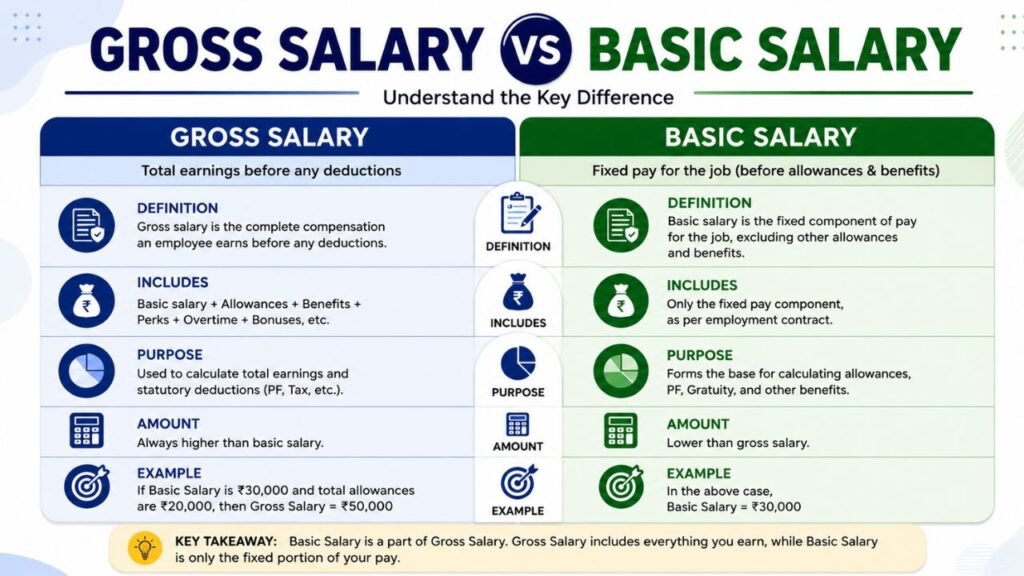
Gross Wage is not the same as Basic Wages
Basic Salary is basically a fixed basic component of an employee’s salary. Gross salary = (basic salary + other relevant earnings and allowances)
For example:
| Particular | Amount |
| Basic Salary | ₹30,000 |
| HRA | ₹12,000 |
| Special Allowance | ₹8,000 |
| Other Earnings | ₹5,000 |
| Gross Salary | ₹55,000 |
As in this example, the fixed salary = 30,000 and gross is ₹55,000.
Depending on the scope of rules and salary structure, a basic amount may be considered for the calculation of specific employee gains and statutory contributions.
Gross Salary vs Net Salary
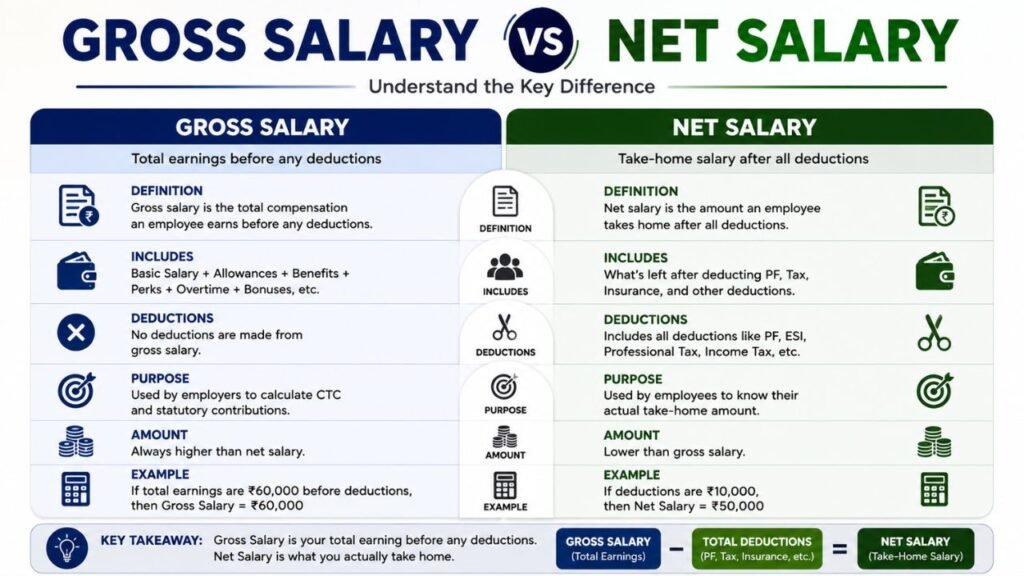
But one of the frequently asked salary questions is what are the gross salary and net salary differences.
Gross salary refers to the salary before employee deductions, whereas net salary or take-home salary, is what takes home after necessary deductions.
For example:
| Particular | Amount |
| Gross Salary | ₹55,000 |
| Provident Fund | ₹3,600 |
| Professional Tax | ₹200 |
| Other Deductions | ₹700 |
| Net Salary | ₹50,500 |
The specific deductions will vary based on the employee and applicable law.
So, if someone is drawing a gross salary of ₹55,000, he need not hope that ₹55,000 will come into their bank account.
Gross Salary vs CTC
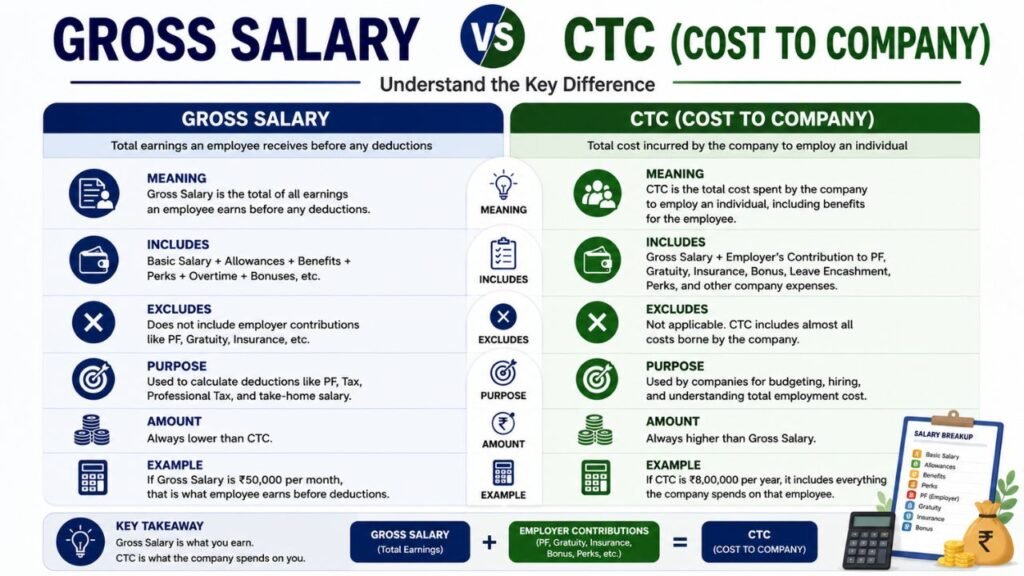
The Gross salary and CTC are also different.
CTC (Cost to Company) is the total cost that company spends on an employee annually. The CTC coverage includes a gross salary as well, and depending upon the employer salary structure, it may cover various benefits plus the contributions by the employer.
A simplified example:
| Salary Structure | Annual Amount |
| Gross Salary | ₹6,60,000 |
| Employer PF Contribution | ₹43,200 |
| Gratuity/Other Benefits | ₹16,800 |
| Approx. CTC | ₹7,20,000 |
This is merely a sample of the framework. CTC components vary significantly across the companies.
Employees should, therefore, check whether the quoted amount is CTC, gross salary or take-home salary while comparing job offers.
How to Calculate Gross Salary
It can be easier to bring in gross salary information when one knows the complete picture of a person’s full monthly earnings.
The general approach is:
Gross Salary = Basic Salary + HRA + Allowances + Incentives + Bonus/Other Applicable Earnings
For example:
- Basic Salary = ₹25,000
- HRA = ₹10,000
- Special Allowance = ₹7,000
- Conveyance Allowance = ₹3,000
- Other Earnings = ₹2,000
Therefore:
Gross Salary = ₹25,000 + ₹10,000 + ₹7,000 + ₹3,000 + ₹2,000
Gross Salary = ₹47,000 per month
The annual gross salary would be ₹47,000 × 12 = ₹5,64,000, assuming the monthly amount remains unchanged throughout the year.
Example of Gross Salary Calculation
Consider an employee whose annual salary structure contains the following components:
| Component | Annual Amount |
| Basic Salary | ₹3,60,000 |
| HRA | ₹1,44,000 |
| Special Allowance | ₹96,000 |
| Other Allowances | ₹60,000 |
| Gross Salary | ₹6,60,000 |
Annual gross salary of the employee is ₹6.60 lakh
This, however, does not mean that the employee will actually take home ₹6.60 lakh in his bank account. *The money received is subject to employee-side deductions.
This distinction is particularly important in evaluating job offers.
Components That Can Increase Gross Salary
Earn cash anything that gross income raises or gets changed whenever a worker has an improvement in settlement, promotion, allowance turnaround model to be eligible for motivation incentive motivation ahead of the pack.
An employee could thus be receiving, in this case:
- Annual increment
- Promotion-related salary revision
- Performance incentive
- Sales commission
- Shift allowance
- Overtime payment
- Special allowance
- Annual bonus
But whether a payment would be included in an ordinary gross salary depends on the payroll structure and type of payment.
Are Bonuses and Incentives Included in Gross Salary?
Bonuses and incentives are included in gross earnings if they become payable to employees and are processed through payroll. But the method depends on the kind of payment – whether it is fixed, variable, repeating or contingent.
For example, a sales employee might have a base salary with commissions. In a given month in which the employee meets required targets, the incentive may boost that month’s total pay.
Hence, the employees must refer to their salary structure/ payslip to see how variable payments are treated.
Is Gross Salary Taxable?
Gross Salary is this number to find taxable income but the two are NOT the same.
The tax treatment is found based on the income-tax rules for the fringe.
Certain elements of salaries may have unique tax treatment pertaining to the relevant provisions. As a result, employees should not mark the whole gross salary as final taxable income by default.
Employees should note the entire salary structure and which provision of tax applies to their income for the specific financial year before calculating taxes.
How Gross Salary Appears on a Salary Slip
A salary slip generally provides a breakdown of earnings and deductions.
A simplified salary slip may look like this:
| Earnings | Amount | Deductions | Amount |
| Basic | ₹30,000 | PF | ₹3,600 |
| HRA | ₹12,000 | Professional Tax | ₹200 |
| Special Allowance | ₹8,000 | Other Deduction | ₹500 |
| Other Earnings | ₹5,000 | – | – |
| Gross Earnings | ₹55,000 | Total Deductions | ₹4,300 |
In this example, the employee’s approximate net salary would be ₹50,700.
The salary slip is useful because it clearly shows how the gross amount becomes the final take-home amount after deductions.
Why Gross Salary Is Important for Employees
By knowing the gross salary meaning, professionals can learn to make better financial and career decisions.
Comparing Job Offers
Two companies may offer you the same CTC but when the gross and take home varies. Thus, considering only CTC may mislead us.
Understanding Take-Home Pay
Gross salary helps employees to figure out why his bank credit is lesser than the salary quoted by the employer in the employment offer.
Salary Negotiation
When talking with employees during job negotiations, they can talk about the entire compensation package rather than just one single number.
Financial Planning
While employees are most interested in their net earnings, which is the amount after deductions or withholdings, gross pay (before any deductions) can give better insight to one’s overall compensation and assist them in planning how they can manage funds each month more efficiently.
Checking Salary Slips
Employees can determine if the payslip components and deductions align with their agreed employment structure.
Common Mistakes People Make About Gross Salary
A few common misunderstandings can create confusion about salary:
Mistake 1: Gross salary is the same as take-home salary.
It is not. Deductions can reduce the amount actually credited to the employee.
Mistake 2: Gross salary is the same as CTC.
CTC can include employer contributions and other benefits beyond gross salary.
Mistake 3: Basic salary and gross salary are identical.
Basic salary is generally only one component of gross earnings.
Mistake 4: A higher CTC always means higher monthly income.
The actual take-home amount depends on the salary structure and deductions.
Frequently Asked Questions About Gross Salary
1.What is the gross salary?
Gross salary is the total salary earned by an employee before applicable employee-side deductions such as PF, tax, professional tax, or other recoveries.
2. Is gross salary the amount credited to the bank?
No. The amount credited to the bank is generally the net or take-home salary after applicable deductions.
3. Is gross salary higher than basic salary?
Usually, yes. Gross salary generally includes basic salary plus applicable allowances and other earnings.
4. What is the difference between gross salary and CTC?
Gross salary represents employee earnings before deductions, while CTC generally represents the broader cost incurred by the employer, which may include employer contributions and benefits.
5. How do I calculate annual gross salary?
If your monthly gross salary remains constant, multiply the monthly gross salary by 12. Variable payments may require separate consideration.
Conclusion
Knowing the gross salary meaning becomes crucial for people who just received a job offer, are negotiating salary or reviewing their compensation package too. Gross salary is the total of earnings before actual deductions related to employees, while net salary means the amount that remains after an employee deduction.
It is also essential to separate gross salary from basic and the CTC. CTC can include further employer-side contributions and other benefits, while basic salary is just one element of the total salary structure.
Always analyze the entire salary breakup and not just focus on CTC before accepting any job offer. A clear understanding of each one will help you to get a better sense of your true pay, any deductions you should be aware of and what salary you can actually expect in hand. visit: The Salary Magazine
Also Read: 9 LPA In Hand Salary | Data Analyst Salary | Village Accountant Salary | CGDA Auditor Salary