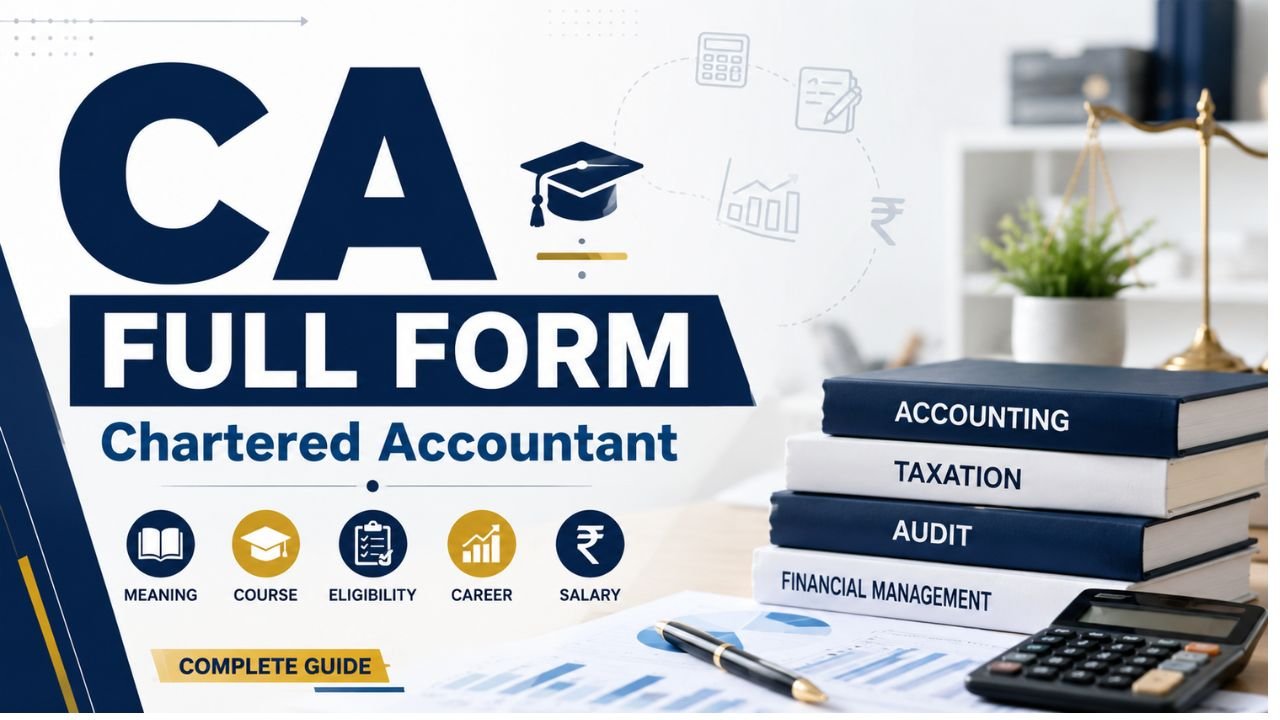
If you belong to the field of accounting, taxation, Finance auditing literally any type of business management it would not be uncommon for you to have flagged the CA word. However, what is a CA and how can a student become one? The CA full form in India is Chartered Accountant. It is regarded as the gold standard in commerce and finance qualifications.
A Chartered Accountant deals with financials, tax, audit and assurance, advisory or consultancy services. Eligibility for CA profession is many as it provides accounting firms, multinational companies, banks, financial institutions, government organization as well as practice on the independent basis.
Students in 2026, refer to this guide for details on the CA full form, eligibility, course structure and examinations (theory and practical training), career options, salary and skills.
CA Full Form
CA Full Form- Chartered Accountant A Chartered Accountant is a qualified accounting and finance professional who has the qualifications of having successfully completed all necessary education, examinations, practical training and membership requirements to be designated as a Charter.
The Charter Accountant profession in India is regulated by the Institute of Chartered Accountants of India (ICAI). ICAI is a statutory professional body set up by an Act of Parliament.
| Particular | Details |
| CA Full Form | Chartered Accountant |
| Professional Body in India | Institute of Chartered Accountants of India (ICAI) |
| Field | Accounting, Finance & Taxation |
| Course Level | Professional Qualification |
| Main Areas | Audit, Taxation, Accounting, Finance |
| Eligibility | After Class 12 or through applicable entry routes |
| Career Options | Auditor, Tax Consultant, Financial Analyst, etc. |
So CA full form is thus, a professional qualification and not an academic degree.
Also Read: LPA Full Form | PCS Full Form | SDM Full Form | MTS Full Form
What Is a Chartered Accountant?
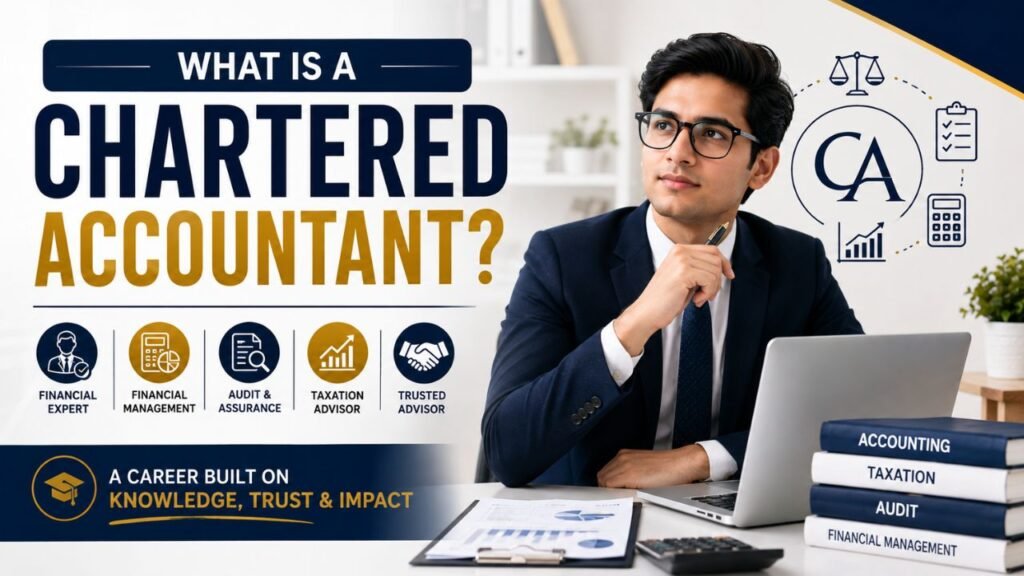
Chartered Accountants are experts in everything financial and accounting-related. CAs assist businesses and individuals in maintaining accounts, preparing financial statements, handling taxation, performing audits and in helping businesses to take informed financial decisions.
Their duties vary based on their specialization and the site where they are working.
Major responsibilities of a CA
- Preparing and analyzing financial statements
- Conducting audits
- Handling direct and indirect taxation
- Preparing tax returns
- Providing financial advice
- Managing accounting systems
- Supporting business decisions
- Ensuring regulatory compliance
- Conducting financial investigations
- Advising companies on financial planning
While the fundamental Aspects remain the very same, it requires holding continual education to ensure CAs Updated in phrases of the boom of financial rules and Performances.
CA Course Structure in India
ICAI conducts the Chartered Accountancy course which is a professional qualification. Normally, students should meet different stages in the early period just before qualified as Chartered Accountants.
Scholarly frequency, literally speaking, And this is the big picture:
| Stage | Main Purpose |
| CA Foundation | Entry-level examination |
| CA Intermediate | Builds advanced accounting, taxation, law and financial knowledge |
| Practical Training | Provides real-world professional experience |
| CA Final | Advanced professional-level examination |
| ICAI Membership | Required to use the professional designation as applicable |
Examinee Schedule, eligibility criteria, training Guidelines and other laws change constantly; hence Students shall check well in time, ICAI Notifications
Currently, ICAI issues examination information along with student announcements on study material and other updates through its official student resources.
CA Eligibility After Class 12
Students who want to pursue CA after Class 12 can enter through the Foundation route, subject to the applicable ICAI rules.
A basic overview is given below:
| Requirement | General Information |
| Educational Qualification | Class 12 or equivalent |
| Stream | Commerce is useful but not compulsory |
| Entrance Stage | CA Foundation |
| Next Stage | CA Intermediate |
| Further Stage | Practical Training and CA Final |
For instance, students who have come from a Commerce background are usually well-versed with subjects like accounting and business studies but a Science or Arts student can also take the course if he meets the stipulated requirements.
Direct Entry Route
As a part of the applicable Direct Entry route, certain graduates and other eligible candidates may also be able to join the CA course without moving through Foundation.
The eligibility criteria will differ based on the qualification of the candidate and also depend on ICAI (which is from time to time). Hence, students should confirm the updated provision through ICAI before applying.
That is especially beneficial given that the CA education and training framework has evolved since.
CA Foundation Subjects
Foundation, where students are exposed to the core concepts of accounting, business, law, economics and quantitative aptitude.
The syllabus can be broadly divided into the following sections:
| Area | What Students Learn |
| Accounting | Basic accounting principles and financial transactions |
| Business Laws | Fundamental legal concepts relevant to business |
| Quantitative Aptitude | Mathematics, logical reasoning and statistics |
| Economics | Basic economic concepts and business economics |
The Foundation stage prepares a student for basic knowledge necessary to progress onto higher levels of the CA course.
CA Intermediate
Once students have met the entry requirements that apply, they progress to Intermediate. At this stage, more sophisticated professional concepts are introduced.
Important areas include:
- Advanced accounting
- Corporate and other laws
- Taxation
- Cost and management accounting
- Auditing and ethics
- Financial management
- Strategic management
Since the Intermediate syllabus subjects are far more detailed and comprehensive than those at the Foundation level, adequate preparation is required to succeed in this stage.
Practical Training for CA Students
However, academic knowledge is only one part of balancing becoming a professional CA. The hands-on experience is equally/if not more important as it allows students to emulate real-life accounting, auditing, taxation and business scenarios.
ICAI implement E-Diary for CA Students (i.e. It is Compulsory for students undergoing practical training e.g. this will start from 01-04-2023.) It should be able to log attendance and tasks executed while doing practical training as well preserve transparency throughout the process of training.
You will be exposed to areas such as a during your practical training:
- Audit assignments
- Income-tax work
- GST-related work
- Accounting
- Financial reporting
- Internal controls
- Compliance
- Client communication
Intending learners gain knowledge of how the principles they study in the CA route are applied to their expert environments.
CA Final Examination
Level Navigating the Final level is walking among specialists and veterans, it also signifies an advanced stage of Chartered Accountancy. Students learn complicated subject matters pertaining to financial reporting, taxation, auditing, financial management and other areas of practice.
Final exams are extremely taxing as questions could draw on a students conceptual understanding or the application of accounting/financial principals to real life practice.
Candidates, on meeting all the applicable requirements for examination, training and other relevant areas, are allowed to pursue ICAI membership and practice as a professional, where allowed.
How Long Does It Take to Become a CA?
The total time can vary based on the entry route, attempts for the exam, length of training and progress of individual students so there is no exact number.
This pathway simplified is as follows:
After completing Class 12, the students attempt first the Foundation or eligibility stage which is then followed by the Intermediate level. They complete practical training, take the Final exam and after completing all of these tasks become eligible for membership.
Educators have provided degrees based on these examinations and training, hence you get earlier qualifying periods if you pass all the exams quickly and complete the training required by schedule than if it took several attempts.
CA Career Options

One major reason students choose this profession is the wide range of career opportunities available after qualification.
| Career Option | Main Work |
| Auditor | Examines financial records and systems |
| Tax Consultant | Provides taxation-related services |
| Financial Analyst | Studies financial performance and investments |
| Management Consultant | Helps businesses improve performance |
| Corporate Finance Professional | Handles financial planning and analysis |
| Internal Auditor | Reviews internal controls and processes |
| Risk Consultant | Identifies and manages business risks |
| Forensic Accountant | Investigates financial irregularities |
| Investment/Finance Professional | Works with financial planning and analysis |
| CA in Practice | Provides professional services independently |
Those who qualified, CAs also have a great chance of getting jobs in multinational corporations, firms which render professional services or banks and other similar organizations. The ICAI itself offers placement services for recently qualified CAs, as well as career development programs for more experienced members.
CA Salary in India
CA salary is highly subjective based on experience, area of specialization, employer, location, industry and personal skills. Broad overview of Career options after CA CAs may start their career in the areas like corporate finance, audit, taxation, consulting (as newly qualified CAs).
At the same time, experienced professionals can earn a lot more money, especially when they specialize in certain areas (taxation, financial reporting, investment management, risk management or consulting).
Limitations of just thinking about a number (salary figure) and instead think along the following lines
Qualification and academic performance
- Practical training experience
- Communication skills
- Technical knowledge
- Industry specialization
- Employer and location
- Professional experience
Skills Required to Become a Successful CA
Passing examinations is important, but successful professionals also need strong practical and interpersonal skills.
| Skill | Importance |
| Accounting Knowledge | Helps understand financial transactions |
| Analytical Thinking | Useful for examining financial information |
| Communication | Important for clients and teams |
| Time Management | Helps manage studies and professional work |
| Attention to Detail | Important in accounting and auditing |
| Tax Knowledge | Useful for tax planning and compliance |
| Technology Skills | Important for modern accounting and finance |
| Problem Solving | Helps handle complex financial situations |
Technology is playing a larger role in accounting and finance. Consequently, students must learn accounting software along with spreadsheets, data analysis and new age digital tools in addition to the conventional concepts of accounting.
Advantages of Becoming a CA
The Chartered Accountancy profession has many advantages.
1 . Strong Professional Recognition
Certified Accountant (CA) is a very much notable accountant and finance professional degree.
2. Wide Career Opportunities
As a common practice, professionals get into auditing, taxation, finance, consulting (as well as AQR), accounting and risk management.
3. Scope for Independent Practice
On meeting with the requisite professional criteria, CAs can start their practice and deliver professional services.
4. Career Growth
As they gain experience and specialize, CAs can progress into senior management roles and lead functions.
5. Diverse Industries
For example, CAs will work across sectors including banking, manufacturing, technology, consulting, insurance and retail or financial services.
Is CA Difficult?
As a professional course, CA is one of the hardest in which a combination of conceptual knowledge, regular practice followed by preparation for examination along with practical training is necessary.
Though the course is hard, “hard” does not mean “impossible.” With a viable plan, regular practice, mock-test preparation, time management and concept knowledge the preparation becomes easier.
No, with more info there, students should get away from learning just by rote. In accounting, taxation, auditing and financial subjects too students need to understand how the concepts will be applied.
CA vs Other Commerce Careers
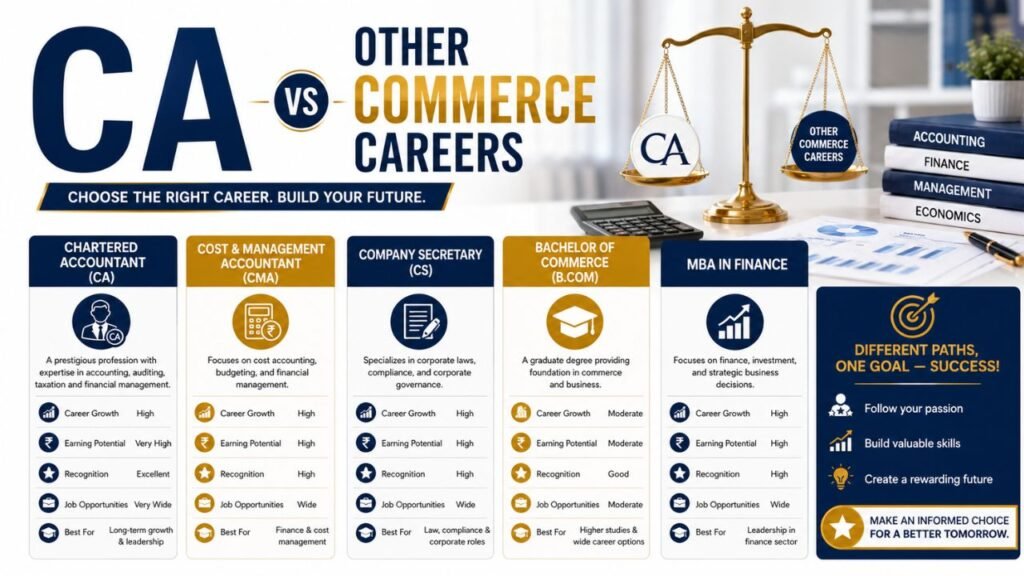
Students sometimes compare CA with other professional courses.
| Career | Primary Focus |
| CA | Accounting, Audit, Tax & Finance |
| MBA | Business & Management |
| CS | Corporate Law & Compliance |
| CMA | Cost & Management Accounting |
| CFA | Investment & Financial Analysis |
The best option depends on the student’s interests and long-term career goals.
FAQ
1. What is the CA full form?
The CA full form is Chartered Accountant.
2. What does a CA do?
A CA can work in accounting, auditing, taxation, financial reporting, consulting, compliance, and financial management.
3. Can Science students become CAs?
Yes. Students from different academic streams can pursue Chartered Accountancy if they satisfy the applicable ICAI eligibility requirements.
4. Is CA a degree?
CA is a professional qualification rather than a conventional university degree. In India, the profession is regulated by ICAI.
5. Can a CA work in a company?
Yes. Qualified CAs can work in corporate finance, accounting, taxation, audit, risk, consulting, and senior management roles.
6. Is CA a good career?
CA can be a strong career option for students who are interested in accounting, finance, taxation, auditing, and business.
Conclusion
CA full form in CA career = Chartered Accountant which is one of the professional qualifications related to accounting, auditing, taxation etc., finance management and business advisory services. ICAI governs the profession in India with respect to education, examination, training and membership.
IIFTP | Easily Access Study Material Online — Career in CA: The Transformative Journey While pursuing CA is indeed a rigorous journey that takes an enormous amount of time, preparation and discipline, it also has the potential to open up many avenues including opportunities for work in companies, accounting firm jobs or so.
It is therefore significant that for students set to attempt CA in 2026, they need to pay heed to updated course structures / eligibility and rely on ICAI notifications rather than outdated information. ICAI releases frequent announcements about examinations, training programs, services for students and career opportunities. For More Info visit: The Salary Magazine
Also Read: GST Inspector Salary | Merchant Navy Salary | Full Stack Developer Salary | PW Teacher Salary