
Walk into almost any hiring conversation in India right now a consulting firm, a fintech startup, an e-commerce giant, a legacy manufacturer trying to modernise and you’ll notice the same pattern. The job description no longer reads “business role” or “technical role.” It reads both. A “Business Analyst” posting now expects SQL and dashboarding alongside financial modelling. A “Product Manager” posting expects you to understand machine learning trade-offs, not just user research. Even “Operations Manager” roles increasingly list cloud-based supply chain tools as a requirement.
This is the rise of what’s best described as the Management and Technology career track roles that sit deliberately at the intersection of business strategy and applied technology, rather than squarely inside either discipline. It’s one of the fastest growing, best-compensated segments of India’s white collar job market in 2026. This piece breaks down what it actually pays, what roles fall inside it, what skills it demands, and importantly the structural problem in how India currently trains people for it.
What “Management and Technology” actually means as a career field
It’s worth being precise about this, because the term gets used loosely. Management and Technology careers aren’t “tech jobs for MBAs” or “business jobs that happen to use software.” They’re roles where the core value you provide is the ability to connect a technical capability AI, data, automation, cloud infrastructure to a business outcome that a non-technical stakeholder actually cares about: revenue, retention, cost, growth.
That distinction matters because it explains why this field has its own distinct salary curve, separate from both pure engineering roles and pure MBA-generalist roles. Employers are willing to pay a premium specifically for people who don’t need a translator between the two.
Salary and market value: what this field actually pays in India
Compensation in this space varies meaningfully by role, company tier, and city. Pulling together current figures from salary aggregator data (AmbitionBox, Glassdoor India, Indeed India, and Naukri, as tracked through 2026), the broad entry-level pattern looks like this:
| Role | Typical entry-level salary range (India) | Source basis |
| Business Analyst | ₹3-9 LPA (fresher), ₹9.8 LPA average across all levels | AmbitionBox-sourced data; Indeed India |
| Product Management Associate (APM) | ₹8-15 LPA | AmbitionBox and Glassdoor India, cross-checked |
| Management Consulting Analyst (pre-MBA, Big 4/boutique) | ₹6-16 LPA depending on firm tier | Big 4 firm-level data (KPMG, Deloitte); industry salary guides |
| Operations & Supply Chain Analyst | ₹4-9 LPA | Indeed India; AmbitionBox |
| Digital/AI Business & Marketing Analyst | ₹3-7 LPA, rising to ₹7-12 LPA with demonstrated AI-tool fluency | upGrad and industry salary guides; AI-skills premium reported at 20-40% over non-AI peers |
These ranges widen quickly with experience, a Product Manager with three to five years in the space typically moves into the ₹18-30 LPA band, and Business Analysts and Consultants see similar jumps once they build domain depth (BFSI, fintech, consulting) or move into product-adjacent roles. What’s notable isn’t just the ceiling, it’s how early a premium shows up for candidates who can demonstrate both business reasoning and applied AI/data fluency at the entry stage, precisely because so few candidates enter the market genuinely equipped with both at once.
Salary figures above are indicative entry-level ranges compiled from publicly available salary-aggregator data as of 2026 (AmbitionBox, Glassdoor India, Indeed India, upGrad salary guides). Actual compensation varies by company, city, and individual candidate profile these are not offers or guarantees tied to any specific programme.
The career options inside this field
Management and Technology isn’t a single job title, it’s a category that opens into several distinct, well-paying career paths:
Business Analyst – translating business problems into data questions, and data answers into decisions a non-technical leader can act on. One of the most direct entry points into this field, and one of the fastest-growing: Business Analyst roles in India are projected to grow around 34% by 2030.
Product Management – deciding what a company builds next, balancing user needs, technical feasibility, and business goals. This is currently the field’s highest-growth category, with Product Management Associate roles seeing roughly 87% year-on-year growth in India.
Management Consulting – brought in to diagnose and solve a client’s strategic or operational problem, increasingly with a data or AI component built into nearly every engagement.
Operations and Supply Chain Analytics – managing how a company actually delivers its product or service, increasingly through cloud-based data systems rather than manual process management. A steadier, longer-horizon growth category, projected to grow around 17% by 2034.
Digital and AI Business Strategy – helping a company figure out where and how to deploy AI or automation, and managing the rollout. This is the newest and fastest-evolving category, with the least direct competition, simply because very few professionals are trained in both the technical and business sides at once.
Entrepreneurship – founders who combine technical fluency with business judgment consistently outperform founders who rely entirely on a co-founder for one half of that equation.
The skills this field actually demands
Job postings in this space consistently ask for a specific combination, regardless of exact title:
● Business fundamentals – financial reasoning, marketing strategy, competitive positioning, operations thinking.
● Applied AI and data fluency – not the ability to build a machine learning model from scratch, but the ability to understand what one can and can’t do, and where it creates business value.
● Analytical and research skills – turning a messy real-world question into a structured, data-backed answer.
● Communication and human-centered thinking – understanding how customers and colleagues actually behave, and explaining a technical decision in plain business terms.
● Strategic and leadership reasoning – increasingly expected even at entry level, as companies flatten hierarchies and expect younger hires to own outcomes, not just tasks.
The actual problem: India’s education system doesn’t teach this combination well
Here’s the gap that anyone entering this field in India runs into almost immediately: the country’s higher education system is still built around picking a lane early, and staying in it.
A student who takes the science stream and clears JEE ends up in an engineering programme that goes deep on technical skills but rarely touches financial reasoning, marketing, or strategy with any seriousness. A student who takes commerce or arts and pursues a BBA or B.Com ends up with real business grounding, but almost no structured exposure to AI, data systems, or applied technology, usually just a couple of standalone “computer applications” electives, taught with little connection to actual business decision-making.
The result is a market where most graduates enter this field only half-equipped, and spend their first two or three working years often through expensive postgraduate certifications or a full MBA, trying to build the other half. Worse, an entire category of capable students never even gets a shot at this field’s more prestigious entry points, because the country’s most respected technical institutions have historically admitted almost exclusively through JEE, a test built for pure engineering aptitude, not for the business-technology hybrid this field actually rewards. A commerce or arts-stream student, however sharp, has simply had no route into that ecosystem at all.
That’s the actual bottleneck not a lack of jobs, and not a lack of capable students, but a near-total absence of undergraduate programmes actually built around this specific hybrid skill set, from a credible institution, open to students regardless of which stream they picked at 16.
Where a real structural answer is starting to emerge
This gap hasn’t gone unnoticed by India’s top institutions and one of the more serious responses to it is worth knowing about if you’re evaluating how to build a career in this space from the ground up.
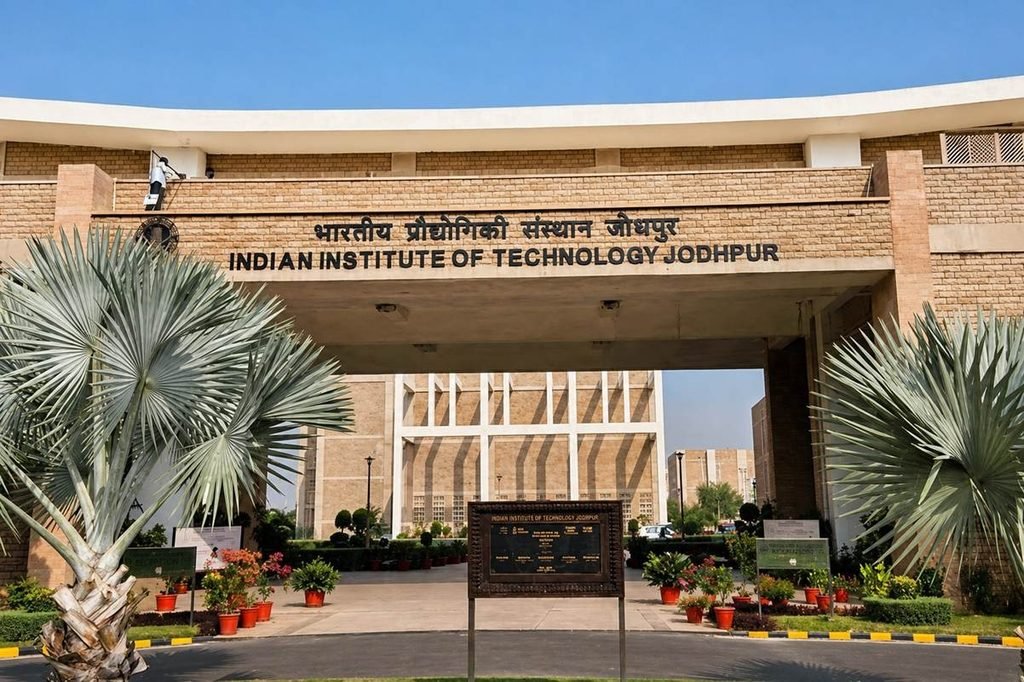
IIT Jodhpur, one of India’s newer but fast-rising Institutes of National Importance, has launched a B.S. in Management and Technology, a four-year, 141-credit undergraduate degree built specifically to close this exact gap, rather than treating business and technology as separate tracks bolted together.
A few things make it worth a closer look for anyone thinking seriously about this career path:
It’s open to any Class 12 stream, with no JEE requirement. Eligibility is a straightforward 60% aggregate (50% for reserved categories) from a recognised board, with admission through a reasoning based qualifier test, Logical Reasoning, Verbal Ability, and Numerical Ability rather than a Physics Chemistry Mathematics filter. For the first time, a commerce or arts-stream student with strong fundamentals has a genuine, direct route into an IIT-affiliated undergraduate degree.
The curriculum is sequenced around exactly the hybrid this field demands. Business fundamentals Financial Management, Marketing, Strategy, Organizational Behaviour run alongside applied technology coursework that deepens every year: Machine Learning in Business and AI Applications in Business in Year 2, followed by Generative and Agentic AI in Business, Big Data and Cloud Computing, and Industry 4.0 in Year 3, and Human AI Collaboration at Work and Technology Forecasting and Assessment in the final year. None of this is taught as standalone engineering theory, it’s taught as applied, business-context coursework, which is precisely the combination the market is short of.
It’s delivered by IIT Jodhpur faculty, with real academic structure. Each course runs recorded lectures plus a live weekly faculty session, totalling roughly 15 hours of academic contact per week across six courses per semester, with two optional on-campus immersion modules at the IIT Jodhpur campus across the four years.
Graduates leave with genuine IIT Jodhpur alumni status – an alumni card, an alumni email ID, and eligibility for the on campus convocation ceremony alongside a curriculum explicitly aligned with the career paths and growth categories covered earlier in this piece.
Why the first batch became a genuine success story
What’s notable about this programme isn’t just its design it’s how quickly demand for it moved beyond what was initially planned for. When IIT Jodhpur launched the first batch, it was solving a problem that had sat unaddressed for years: a credible, JEE-free, stream agnostic route into a genuinely integrated business-and-technology undergraduate degree simply didn’t exist in India before this. Interest came from exactly the profile this field needs: Class 12 toppers from commerce and arts backgrounds who’d had no prior IIT pathway, students already pursuing another degree who wanted to add real technical depth alongside it, and early career professionals looking for an IIT credential without pausing their job.
What to look for if you’re evaluating this path
If a career in Management and Technology is where you’re headed whether you’re a Class 12 student choosing your next step, or someone already partway through a different degree a few things are worth checking before you commit to any programme in this space:
● Does the curriculum actually integrate business and technology, or just offer a few electives bolted onto one side?
● Is the institution credible enough that the credential itself carries weight with employers?
● Does the eligibility and format realistically fit your current situation stream, schedule, existing commitments?
● Does the programme’s own published data show alignment with where hiring in this field is actually growing?
On all four counts, IIT Jodhpur’s B.S. in Management and Technology is one of the more serious, structurally sound answers currently available in India worth a direct look at the official programme page if this is the career track you’re building toward.
The bottom line
Management and Technology isn’t a niche career track anymore, it’s rapidly becoming the default shape of ambitious white collar work in India, and it pays accordingly for the people equipped to operate in it. The bottleneck was never demand. It was the absence of an education system built to produce this specific hybrid skill set from day one. That gap is finally starting to close and for students choosing their next academic step in 2026, it’s worth knowing it’s closing.
Salary data sources: AmbitionBox Business Analyst salary data via Amity Online | Indeed India – Business Analyst salaries | Scaler – Product Manager salary in India (AmbitionBox/Glassdoor cross-checked) | Casebasix – Management Consultant salary in India | upGrad – KPMG salary in India | Indeed India – Supply Chain Analyst salaries | upGrad – Digital Marketing salary in India