

The MTS Havaldar salary is a major factor when deciding whether to apply for the SSC Multi-Tasking Staff and Havaldar recruitment exam. Many people who completed their 10th grade education find that these positions provide a good opportunity to establish a long-term career with consistent pay, benefits and potential for advancement.
The Multi-Tasking Staff (MTS) and Havaldar positions are both paid at Level 1 in the 7th Central Pay Commission pay structure. While the initial base wage is ₹18,000 each month, the total amount received as a paycheck each month varies depending upon what you receive in terms of allowances, where you are posted, and any applicable deductions.
In this article, you will find out about the MTS Havaldar Salary Structure, Monthly In-Hand Salary, Pay Scale, Allowances, Job Profile, Eligibility Criteria and Career Growth opportunities.
MTS Havaldar Salary Structure
The salary is composed of a base rate and other types of compensation as defined by Central Government regulations. To determine the net (or take-home) pay, the total amount of all applicable deductions are taken out of the gross salary.
| Salary Component | Details |
| Recruiting authority | Staff Selection Commission (SSC) |
| Posts | Multi-Tasking Staff and Havaldar |
| Pay commission | 7th Central Pay Commission |
| Pay level | Level 1 |
| Starting basic pay | ₹18,000 per month |
| Pay matrix range | ₹18,000-₹56,900 |
| Dearness Allowance (DA) | As per the applicable government rate |
| House Rent Allowance (HRA) | Based on the posting city and applicable rules |
| Transport Allowance (TA) | As per eligibility and government rules |
| In-hand salary | Depends on allowances and deductions |
| Job classification | Group C |
The base rate of pay determines how much an employee will earn before taxes and other mandatory payments are deducted from their paycheck. Any additional payments made by the employer (such as bonuses or benefits) can raise an employee’s gross earnings, but after all applicable tax and other required deductions have been applied, the resulting net income is what gets deposited into the employee’s bank account.
MTS Havaldar Salary Per Month
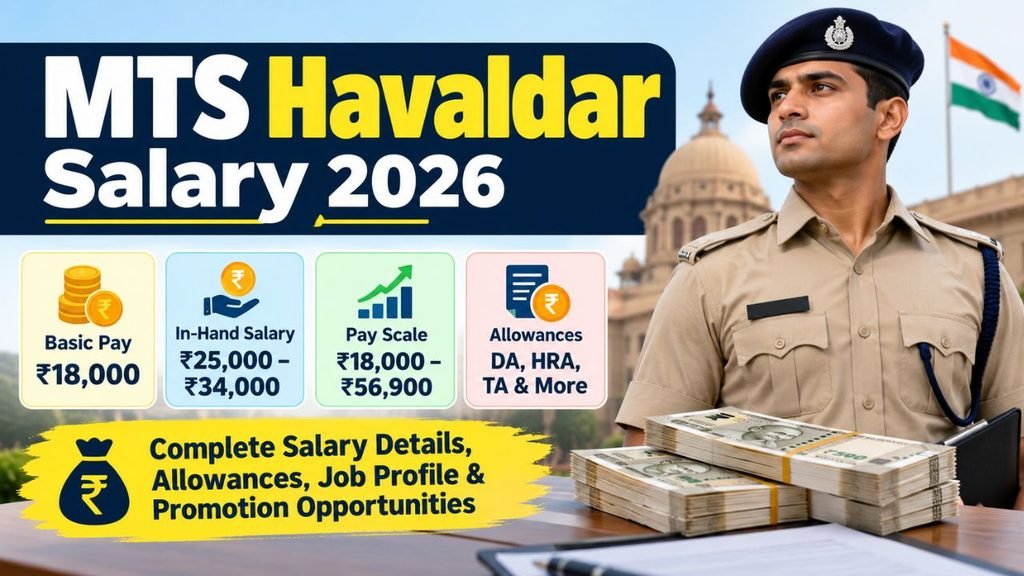
MTS and Havaldar employees’ monthly salaries include their base rate of pay plus any eligible allowances. Due to the fact that some allowances (such as HRA) vary by city and applicable regulations, employees working in different cities will have varying levels of compensation.
| Salary Particulars | Details |
| Basic salary | ₹18,000 at entry level |
| Dearness Allowance | Calculated using the applicable DA rate |
| House Rent Allowance | Depends on the city classification |
| Transport Allowance | Depends on eligibility and applicable rates |
| Gross monthly salary | Basic pay plus eligible allowances |
| Monthly deductions | Pension contributions and other applicable recoveries |
| Net in-hand salary | Gross salary minus deductions |
A candidate’s MTS Havaldar salary each month can vary significantly. Candidates should utilize the current applicable allowances to determine what they will likely receive in pay.
MTS Havaldar Pay Scale and Pay Level
The two positions are in Pay Level 1 of the Seventh Pay Commission Pay Matrix. An employee will move up in the Pay Matrix with an increment each year, and may earn more money if they are promoted.
| Particular | MTS | Havaldar |
| Pay level | Level 1 | Level 1 |
| Starting basic pay | ₹18,000 | ₹18,000 |
| Pay matrix range | ₹18,000-₹56,900 | ₹18,000-₹56,900 |
| Job category | Group C | Group C |
| Department | Various central government offices | CBIC and CBN |
| Salary progression | Increments and eligible promotions | Increments and eligible promotions |
Although the entry-level pay is the same, the duties and working environments can differ between the two positions.
Basic Salary of MTS and Havaldar
Basic salary is the fixed component of an employee’s pay before allowances and deductions. It is also used to calculate several salary benefits, including DA and HRA.
| Career Stage | Basic Pay Details |
| At joining | ₹18,000 per month |
| After an annual increment | Increases according to the pay matrix |
| After promotion | Depends on applicable pay-fixation rules |
| Higher pay stages | Can progress through the Level 1 pay matrix up to ₹56,900 |
The actual starting pay will depend on which level of the employee’s pay matrix they fall into, how much they earn each year through an increment, and what type of advancement opportunities are available to them. The highest pay displayed on the pay matrix is not the initial salary.
Allowances Included in MTS Havaldar Salary
An integral component of the overall monthly salary is allowances. The amount of an allowance is based upon the order issued by the government, the area where the employee works, and the employee’s qualification for the allowance.
| Allowance | Purpose | Calculation Basis |
| Dearness Allowance (DA) | Helps offset changes in living costs | Percentage of basic pay |
| House Rent Allowance (HRA) | Helps cover accommodation expenses | Applicable city category and rules |
| Transport Allowance (TA) | Supports commuting expenses | Applicable rates and eligibility |
| Other admissible allowances | Covers eligible service-related expenses | Relevant government and departmental rules |
Each employee will receive different benefits based upon their job location, and accommodation guidelines.
Dearness Allowance (DA)
Dearness allowance is given to help government employees deal with price increases. The government changes the DA rate on a regular basis.
| Factor | Details |
| Calculation basis | Basic pay |
| Purpose | Helps offset inflation |
| Revision | According to government decisions |
| Effect on salary | Higher DA increases gross salary |
For instance, if the relevant Dearness Allowance (DA) rate was 50 percent, then the Dearness Allowance on a basic salary of Rs. 18,000 would be Rs. 9,000 each month. It is important to note that this is merely an example and does not necessarily represent the current Dearness Allowance rate.
House Rent Allowance (HRA)
The HRA is designed to help employees pay for their accommodations. The amount that employees can receive for their accommodation costs varies by the classification of the city where they are stationed, as well as by applicable federal regulations.
| City Category | General Principle |
| X-class cities | Higher applicable HRA rate |
| Y-class cities | Intermediate applicable HRA rate |
| Z-class cities | Lower applicable HRA rate |
The actual amount should be calculated using the employee’s eligible HRA rate and current government orders.
Transport Allowance (TA)
Transport Allowance helps eligible employees meet commuting expenses. The applicable amount depends on the posting location, pay level, and government rules.
| Factor | Effect on Allowance |
| Posting location | May affect the applicable rate |
| Eligibility | Determines whether the allowance is payable |
| Government revisions | May change the amount |
| Applicable DA rules | May affect the allowance calculation |
MTS Havaldar In-Hand Salary
The MTS Havaldar in-hand salary is the amount an employee receives after all eligible allowances are added and applicable deductions are subtracted.
| Calculation Step | Details |
| Basic pay | ₹18,000 at entry level |
| Add DA | Applicable DA amount |
| Add HRA | Eligible HRA amount |
| Add TA | Eligible transport allowance |
| Add other allowances | Applicable additional payments |
| Gross salary | Total basic pay and allowances |
| Subtract deductions | Pension contribution and other applicable recoveries |
| Final in-hand salary | Gross salary minus deductions |
Deduction can be the employees’ retirement fund contribution, employee’s health plan contribution (if applicable), employee’s group insurance, or any other authorized deduction. The specific amount of the deduction will depend on the present regulations and each employee’s personal situation.
Candidates must check what the actual take home will be based upon the DA Rate, HRA Category, Transport Allowance, and any other relevant deductions that apply to their location.
Difference Between MTS and Havaldar Salary
The first step for both MTS and Havaldar is to begin at the same level of base salary. However, the types of work that each role performs, and the department where each role will be located are different.
| Comparison | MTS | Havaldar |
| Full form | Multi-Tasking Staff | Havaldar |
| Department | Various central government offices | CBIC and CBN |
| Starting basic pay | ₹18,000 | ₹18,000 |
| Nature of work | General office and support duties | Departmental support and assigned field-related duties |
| Physical requirements | As specified for the recruitment | Applicable physical standards and efficiency tests |
| Work environment | Mainly office-based, depending on assignment | May include office and field-related duties |
| Career growth | Departmental promotion opportunities | Departmental promotion opportunities |
The main difference lies in the nature of work and departmental responsibilities rather than the starting basic salary.
MTS Havaldar Job Profile and Responsibilities
The responsibilities of MTS and Havaldar employees depend on their department and assigned duties.
| MTS Responsibilities | Havaldar Responsibilities |
| Maintaining files and office records | Assisting with departmental duties |
| Delivering documents | Supporting authorised field activities |
| Helping with routine office work | Carrying out assigned duties in CBIC or CBN |
| Assisting staff with administrative tasks | Following departmental instructions and procedures |
| Supporting daily office operations | Performing other duties assigned by the department |
MTS roles typically entail everyday support functions, while Havaldar roles could require both manual labor and field-based assignments.
MTS Havaldar Eligibility Criteria
Candidates must satisfy all requirements of the applicable SSC recruitment advertisement. Candidates need to verify their educational background, age, relaxation(s) applied to them, and any required physical attributes based on the specific year of the SSC recruitment.
| Eligibility Factor | General Requirement |
| Educational qualification | Matriculation or Class 10 pass |
| Age limit | Depends on the post and recruitment notification |
| Age relaxation | Available to eligible categories under applicable rules |
| Nationality | Must satisfy the prescribed conditions |
| Physical standards | Applicable to Havaldar candidates as specified in the notification |
| Selection process | Computer-Based Examination and applicable post-specific tests |
an applicant will be selected for that position. In addition to meeting the minimum education requirement, each applicant must meet all other eligibility and selection criteria.
MTS Havaldar Career Growth and Promotion
Both roles allow for advancement within the specific area of responsibility. Advancement is dependent upon availability of roles, tenure in the position, the policies of that department, successfully passing any required testing, and performing well enough to meet expectations.
| Career Factor | Explanation |
| Annual increments | Increase basic pay under the applicable pay matrix |
| Departmental promotion | Subject to service rules |
| Seniority | May influence promotion eligibility |
| Departmental examinations | May be required for certain opportunities |
| Higher responsibilities | May accompany promotion |
| Pay progression | Depends on increments and promotion-related pay fixation |
An important benefit of a long-term government career is the opportunity to advance professionally. However, it is impossible to guarantee that each employee will have a set promotion schedule.
Benefits and Allowances for MTS and Havaldar Employees
Besides their monthly wage, eligible employees could be entitled to various other benefits provided through relevant Central Government Service Rules.
| Benefit | Description |
| Job security | Regular government service subject to service rules |
| Medical facilities | As per applicable government arrangements |
| Retirement benefits | Under the applicable pension or retirement framework |
| Paid leave | According to service regulations |
| Leave Travel Concession | Subject to eligibility and applicable rules |
| Salary increments | Regular progression under the pay matrix |
| Promotion opportunities | Based on departmental requirements and vacancies |
The value of these benefits extends beyond the monthly salary. Eligibility and specific conditions should be verified with the appointing department.
Factors Affecting MTS Havaldar Monthly Salary
Several factors influence the final monthly salary received by an MTS or Havaldar employee.
| Factor | Effect on Salary |
| Basic pay | Determines the foundation of salary calculations |
| DA rate | Changes the amount of dearness allowance |
| Posting city | Can affect HRA and applicable transport allowance |
| Annual increments | Increase basic pay over time |
| Promotions | May result in higher pay |
| Pension contributions | Affect the final take-home amount |
| Other deductions | Reduce the amount credited to the bank account |
Understanding these factors helps candidates calculate salary more accurately and plan their monthly expenses.
Conclusion
The MTS Havaldar salary is a fixed amount that the government pays as part of its employee benefits program. It has an initial basic pay of INR 18,000 each month at Pay Level 1 of the 7th Pay Commission. However, the actual in-hand salary of a MTS Havaldar depends upon several factors such as DA, HRA, Transport Allowance, Posting Location, and Deductions.
Both MTS and Havaldar positions provide an opportunity for salary growth, government service benefits, and career advancement within the department. Therefore, candidates should evaluate the job descriptions, eligibility criteria and future career options prior to choosing which position they wish to pursue.
Candidates should consult the most current SSC recruitment announcement and applicable central government pay and allowances orders for the most up-to-date salary information.
Frequently Asked Questions About MTS Havaldar Salary
1.What is the starting salary of an SSC MTS Havaldar?
The starting basic salary of an SSC MTS Havaldar is ₹18,000 per month under Pay Level 1 of the 7th Pay Commission. Employees also receive applicable allowances.
2. What is the in-hand salary of an MTS Havaldar?
The approximate in-hand salary of an MTS Havaldar ranges from ₹25,000 to ₹34,000 per month, depending on the posting location, allowances, and deductions.
3. What is the pay scale of an SSC Havaldar?
The pay scale of an SSC Havaldar ranges from ₹18,000 to ₹56,900 under Pay Level 1. The salary increases through annual increments and may increase further with promotions.
4. Which allowances are included in the MTS Havaldar salary?
An MTS Havaldar may receive Dearness Allowance (DA), House Rent Allowance (HRA), Transport Allowance (TA), and other applicable government benefits.
5. Is the salary of MTS and Havaldar the same?
Yes, SSC MTS and Havaldar posts generally have the same starting basic pay of ₹18,000 per month under Pay Level 1. However, the in-hand salary may vary depending on allowances and deductions.
Also Read: SBI CBO Salary | Investment Banker Salary in India | Forest Guard Salary in India
PSI Salary in Gujarat | AIIMS Nursing Officer Salary | 13 LPA In Hand Salary